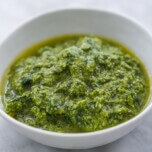
Basil Pesto
This basil pesto is ground by hand in a mortar and pestle, which keeps the leaves bright green and the texture creamy instead of watery. It uses Parmigiano Reggiano alone and raw pine nuts, so the basil stays in front and the finish is mild and buttery.
Servings: 8 people
Calories: 195kcal
Cost: $$
Equipment
- 1 Mortar and Pestle The primary method here. Marble holds the cold and gives the pestle something to grind against.
- 1 Salad spinner Dries the basil fully so the pesto does not turn watery.
- 1 Food processor (optional) The alternative to the mortar. Chill the bowl and blade first if you have time.
- 1 Ice cube tray For freezing the half you are not using right away.
Ingredients
- 2 1/2 cups fresh basil leaves packed, stems removed
- 10 tablespoons Parmigiano Reggiano finely grated; 1/2 cup plus 2 tablespoons
- 2 cloves garlic small to medium, peeled
- 1 1/2 tablespoons raw pine nuts
- 3/4 teaspoon coarse sea salt
- 10 tablespoons extra virgin olive oil
Instructions
- Pick the basil leaves from the stems. Remove the flowering tops, bruised leaves, blackened leaves, and anything that looks slimy. Rinse the basil gently with cold water, then dry it very well. I use a salad spinner for this. Wet basil waters down the pesto and makes it darken faster.2 1/2 cups fresh basil leaves
- Place the garlic and coarse sea salt in a mortar. Grind them together until the garlic turns into a paste. The salt helps break down the garlic as you grind. A food processor also works, but chill the bowl and blade first if you have time.2 cloves garlic, 3/4 teaspoon coarse sea salt
- Add the pine nuts. Grind them with the garlic until the mixture starts to look creamy. I keep the pine nuts raw for this recipe because they give the pesto a mild buttery taste.1 1/2 tablespoons raw pine nuts
- Add the basil a handful at a time. Use a gentle circular motion if you are working with a mortar, and do not pound it. If you are using a food processor, pulse in short bursts and scrape the sides as needed. Stop once the basil turns into a paste. Running it too long turns the pesto dark and makes it taste a little bitter.2 1/2 cups fresh basil leaves
- Transfer the basil mixture to a bowl. Stir in the Parmigiano Reggiano.10 tablespoons Parmigiano Reggiano
- Slowly pour in the olive oil while stirring. The pesto should look glossy and thick, and it should spoon easily. Taste it before adding more salt because the cheese is already salty.10 tablespoons extra virgin olive oil
- Use half of the pesto for pasta and freeze the rest. Share and enjoy!
Notes
Yield – This makes about 1 1/4 cups of pesto. Half of the batch is enough for about 1 pound of pasta, which is what I use in step 7.
Grate the cheese yourself – I prefer grating Parmigiano Reggiano straight from the wedge using a fine grater or Microplane. It blends into the pesto better than the pre-grated kind.
Pick a mild olive oil – Use a mild, fruity extra virgin olive oil so the basil stays in front. A very peppery olive oil can easily take over the flavor.
Serving with pasta – Toss the pesto with hot pasta off the heat. Add 2 to 3 tablespoons of pasta water as needed until the sauce loosens and coats the noodles.
Chill your equipment – If you are using a food processor, chill the bowl for about 15 minutes first. This helps keep the basil from warming up too much while you process it, which also helps preserve its green color.
Nutrition
Calories: 195kcal | Carbohydrates: 1g | Protein: 3g | Fat: 20g | Saturated Fat: 4g | Polyunsaturated Fat: 3g | Monounsaturated Fat: 14g | Cholesterol: 4mg | Sodium: 319mg | Potassium: 42mg | Fiber: 0.2g | Sugar: 0.1g | Vitamin A: 445IU | Vitamin C: 2mg | Calcium: 89mg | Iron: 1mg