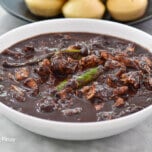
Dinuguan
A rich and savory Filipino stew made with tender pork simmered in vinegar, garlic, and fresh pork blood. Finished with green chili peppers for a gentle heat, this comforting dish is traditionally served with steamed rice or soft rice cakes.
Servings: 6 people
Calories: 453kcal
Ingredients
- 1 lb. pork shoulder diced
- 20 oz. pork blood
- 1/2 lb pork ears boiled and sliced
- 1 cup white vinegar
- 3 cups beef broth
- 3 dried bay leaves
- 1 bunch lemongrass
- 3 long green peppers
- 1 onion chopped
- 5 cloves garlic
- 2 teaspoons sugar
- 3 tablespoons cooking oil
- Salt and ground black pepper to taste
Instructions
- Heat oil in a cooking pot. Sauté the garlic and onion.5 cloves garlic, 3 tablespoons cooking oil, 1 onion
- Once the onion softens, add the pork kasim. Continue sautéing for 2 to 3 minutes.1 lb. pork shoulder
- Add the pork ears. Sauté for 2 minutes.1/2 lb pork ears
- Pour the vinegar. Cover the pot and then let it boil. Stir.1 cup white vinegar
- Pour the beef broth. Let the liquid boil.3 cups beef broth
- Add dried bay leaves and lemongrass. Cover the pot and adjust the heat to the lowest setting. Simmer for 50 minutes or until the pork tenderizes completely. Note: Make sure to stir occasionally. You can add water as needed.3 dried bay leaves, 1 bunch lemongrass
- Pour the pork blood into the pot. Stir. Let the mixture boil and then simmer for 12 minutes.20 oz. pork blood
- Add the long green pepper. Continue cooking for 3 minutes.3 long green peppers
- Season with sugar, salt, and ground black pepper.2 teaspoons sugar, Salt and ground black pepper to taste
- Transfer to a serving bowl.
- Serve hot. Share and enjoy!
Notes
Preventing Pork Blood from Coagulating in Dinuguan
- To prevent the blood in dinuguan from coagulating, it is important to add the pork blood gradually while stirring continuously.
- Cooking the dish over low to medium heat is also crucial, as high heat can cause the blood to curdle or form lumps. Avoid rapid boiling after adding the blood.
- Stirring frequently during the cooking process helps keep the mixture uniform and prevents coagulation.
Nutrition
Calories: 453kcal | Carbohydrates: 17g | Protein: 21g | Fat: 33g | Saturated Fat: 10g | Polyunsaturated Fat: 5g | Monounsaturated Fat: 16g | Trans Fat: 0.03g | Cholesterol: 78mg | Sodium: 593mg | Potassium: 608mg | Fiber: 3g | Sugar: 12g | Vitamin A: 225IU | Vitamin C: 56mg | Calcium: 70mg | Iron: 2mg