Palabok Recipe
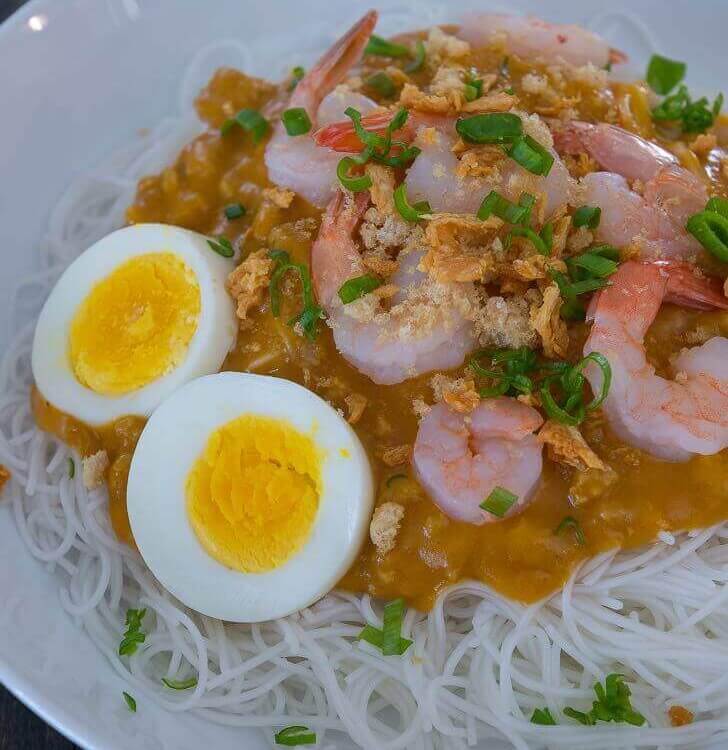
I usually make Pancit Palabok when there is a party to cook for, like a birthday or a fiesta. It has an orange sauce over the noodles, finished with shrimp, sliced egg, chicharon, tinapa flakes, and scallions. Even Jollibee has its own palabok on the menu. Unlike an everyday pancit bihon guisado where everything gets tossed together in one pan, palabok is built in parts and put together only at the end.
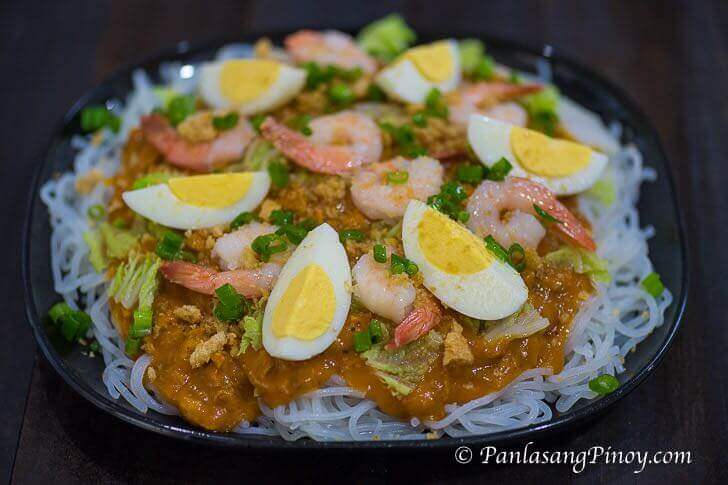
The sauce is where the flavor comes from, so I build mine with tinapa flakes simmered right in, not just sprinkled on at the end. The noodles need a soak before they boil, too, or they stay hard in the middle.
One thing I watch closely is the sauce thickness. Palabok sauce should coat the noodles like a loose gravy instead of sitting on top like paste, so I stir in the flour slurry a little at a time and stop as soon as it clings to the spoon. If it tightens too much while you are plating, a splash of water loosens it right back.
What Is Pancit Palabok?
Pancit Palabok is a Filipino noodle dish with a thick orange sauce made from ground pork, shrimp, and annatto. The noodles are boiled, then topped with the sauce and finished with tinapa flakes, shrimp, hard-boiled egg, chicharon, and scallions. Like other Filipino pancit, it started as a Chinese noodle dish. The word palabok refers to embellishment, in this case the sauce and toppings layered over the noodles.
You usually see palabok at fiestas, birthdays, and Noche Buena. It is often served on a bilao, a wide bamboo tray that holds a big batch for everyone to share.
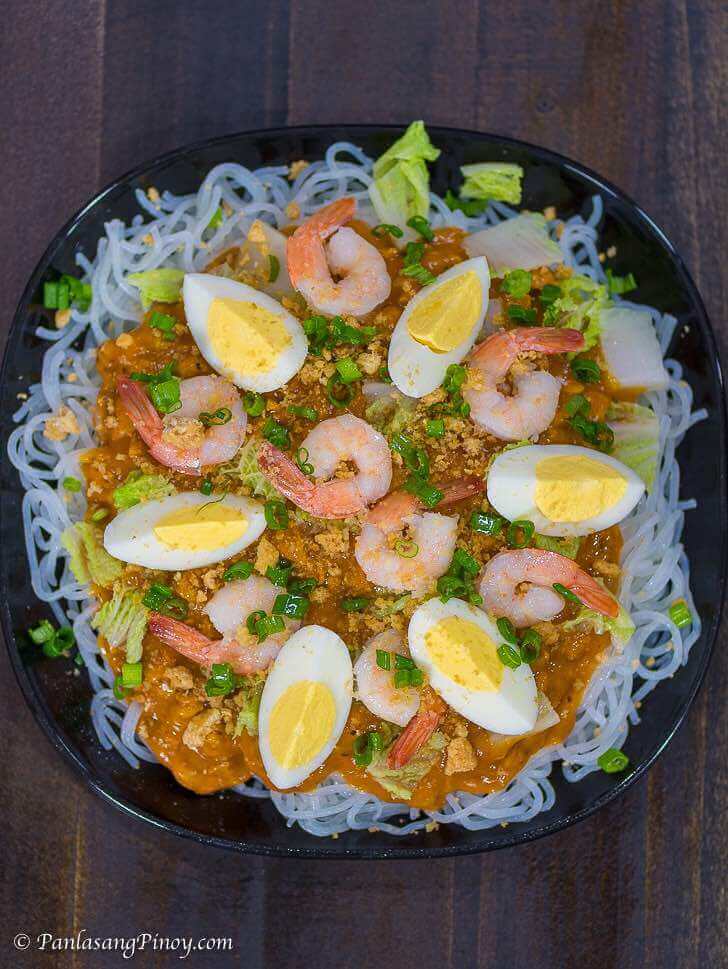
Palabok differs from a stir-fried pancit mainly in the method. You cook the sauce, the noodles, and the toppings separately, then layer them only when it is time to eat. A squeeze of calamansi goes over each serving right before eating.
What Is the Difference Between Palabok, Pancit Malabon, and Pancit Luglug?
People mix up Palabok with Pancit Malabon and Pancit Luglug all the time. The sauce is similar across all three, so the clearest differences are in the noodles and the toppings.
- Pancit Palabok usually uses bihon rice noodles or the cornstarch sticks sold as palabok noodles, both thinner than the thick noodles in Malabon and Luglug. The sauce and toppings go on top.
- Pancit Malabon uses thick rice noodles and more seafood, with squid, oysters, or mussels alongside the shrimp. The sauce is usually mixed through the noodles.
- Pancit Luglug is a Pampanga specialty. The name comes from luglug, the way the thick noodles are cooked, dipped again and again in boiling water in a basket until they soften.
The palabok family stretches a little further, too. There is even arroz palabok, the same sauce and toppings spooned over rice porridge instead of noodles.
Ingredients
- Palabok noodles – The cornstarch sticks sold as palabok noodles at the Asian store. Thin bihon rice noodles also work.
Sauce ingredients:
- Pork shoulder – I slice it into small pieces so it turns tender as the sauce simmers. Pork belly works too if you want it richer.
- Shrimp Cube – Seasons the sauce with shrimp flavor so I do not have to boil a separate stock. One cube is enough for this batch.
- Tinapa flakes – Smoked fish flakes, for the smoky flavor.
- Annatto water – The source of the orange color. Soak the seeds in warm water, then strain so no seeds land in the sauce.
- All-purpose flour – Thickens the sauce. Mix it with water into a smooth slurry first so it will not clump.
- Fish sauce – I use it in place of salt to season the sauce.
- Cooking oil – For sauteing the pork.
- Ground black pepper – Stirred in at the end.
For the toppings:
- Shrimp – Peeled and deveined. I cook them quickly in the noodle water so they stay tender.
- Napa cabbage – A quick one-minute blanch keeps it slightly crisp.
- Hard-boiled eggs – Sliced into quarters and laid over the top.
- Chicharon – Crushed pork rinds. Add it right before serving so it does not go soft in the sauce.
- Scallions – Chopped and scattered over the finished dish.
- Calamansi or lime – I always squeeze some over right before eating.
Tinapa is Filipino smoked fish, usually milkfish (bangus) or herring (tamban), and the flakes carry much of the smoky, salty flavor in the sauce. Outside the Philippines, look for tinapa flakes in the freezer or dry goods aisle of a Filipino or Asian market. If you cannot find them, smoked trout or smoked mackerel has a similar smoky, salty flavor. Peel off any skin and flake the fish before it goes on.
Vanjo’s Advice
Some things that I learned while making palabok over the years:
- Soak the noodles first, and do not skip it. The dried palabok noodles are hard and need to absorb water before they boil, or they stay chalky in the center. I give them at least 30 minutes, longer if the package says so.
- Do not overcook the noodles. Drain them while they are just short of fully soft, since they keep softening under the hot sauce.
- Taste the sauce before you reach for salt. The shrimp cube, tinapa, and fish sauce already carry a lot of salt. I check the seasoning near the end and adjust from there.
- Toast some garlic for the top. I like a spoonful of toasted garlic over the finished plate, and I keep a jar of it ready so it takes no extra time.
- Assemble only when you are ready to eat. The noodles drink up the sauce as it sits, so I plate palabok at the last minute and pass the calamansi around.
- Keep extra chicharon and scallions on the side. The chicharon goes soft once it sits in the sauce, so I keep a bowl of each on the table for people to sprinkle on more as they eat.
How to Cook Pancit Palabok
There are three parts to this Pancit Palabok: the noodles, the sauce, and the toppings. I work through them in that order and assemble the plate last.
Prepare the Noodles
- Soak the palabok noodles in water for about 30 minutes, or follow the timing on the package, then drain.
- Bring a large pot of water to a boil, then add the soaked noodles and cook for 10 to 15 minutes, until soft.
- Drain the noodles well and place them in a large bowl.
- Cover the bowl so the noodles stay soft while you work on the sauce.
The noodles should be soft but not falling apart. If they still have a hard core, give them a few more minutes in the water. These times are for the cornstarch palabok sticks; thin bihon cooks much faster, so start checking it early.
Cook the Shrimp and Cabbage
- Using the same pot of boiling water, add the shrimp and cook for about 1½ minutes, until they turn pink and opaque, then remove and set aside.
- Add the Napa cabbage and boil for 1 minute, then remove and set aside.
Make the Sauce
- Heat the cooking oil in a clean pot, then add the pork and saute until light brown.
- Pour in the fish sauce and annatto water and stir, then add the water. Bring to a boil, cover, and cook over medium heat for 15 to 18 minutes, until the pork is tender.
- Remove the cover, then add the Shrimp Cube and tinapa flakes and cook for 5 more minutes.
- Stir the flour slurry into the pot a little at a time until the sauce thickens, then season with ground black pepper.
Mix the flour with the water until completely smooth before it goes in, and pour it in slowly while stirring. Adding dry flour straight to the hot sauce is what makes it turn out lumpy. If the sauce ever gets thicker than a loose gravy, stir in a little water to loosen it.
Assemble the Palabok
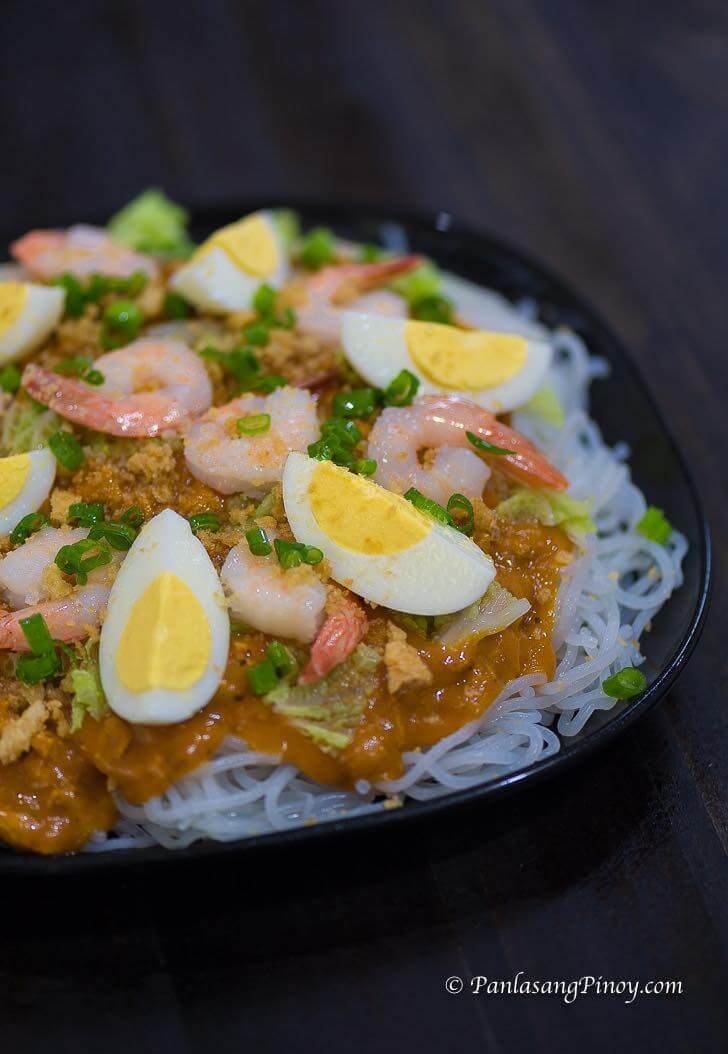
- Place the noodles on a serving plate and pour the sauce over them.
- Top with the Napa cabbage, shrimp, and sliced eggs, then sprinkle the chicharon and scallions. Serve with calamansi or lime on the side.
What to Serve with Pancit Palabok
- Lumpia – Crispy fried spring rolls. I almost always have them on the table when I serve palabok.
- Tokwa’t Baboy – Tofu and pork in a soy-vinegar dip. I like the sharp, sour bite next to a plate of palabok.
- Pandesal – Soft bread rolls for scooping up leftover sauce. I like to tuck a little palabok inside a warm one for a quick sandwich.
- Calamansi on the side – Set out a small dish of halved calamansi so everyone can squeeze on as much as they like.
Storage
Palabok is a party dish, so I almost always end up with leftovers, and the trick is to store the parts on their own. The noodles keep drinking up the sauce as they sit, and if you box everything together overnight, you open the fridge to one soft, sauce-logged clump.
- Refrigerator: Keep the sauce, noodles, and toppings in separate airtight containers for up to 3 days. I plate each serving fresh, sauce first and then the toppings, so even a day-three plate feels like I just made it.
- Freezer: The sauce is the part that freezes well, and it keeps for up to 2 months. I never freeze the noodles or toppings, since they turn soft and lose their bite, so I cook those fresh when I am ready for round two.
- Reheating: Warm the sauce gently with a splash of water to loosen it, then toss it through the noodles and pile the toppings back on. A fresh squeeze of calamansi brings it right back to life.
More Pancit Recipes
If palabok pulls you into the world of pancit, here are a few more from the site that I cook on repeat.
- Pancit Canton – Wheat noodles with pork, shrimp, and vegetables, all tossed in one pan. This is my everyday, no-occasion-needed kind of pancit.
- Pancit Sotanghon – Made with clear, slippery glass noodles instead of rice sticks. I turn to it when I want something a little lighter than palabok.
- Pancit Habhab – From Lucban, eaten straight off a banana leaf with no fork in sight. Messy, and half the fun is in that.
- Pancit Cabagan – A saucy Isabela dish made with fresh miki noodles and topped with crispy pork (lechon carajay) and quail eggs.
- Pancit Bato Guisado – Made with the springy dried noodles that come from Bato, Camarines Sur.
- Pancit Batil Patung – From Tuguegarao, topped with a poached egg and served with a side of egg-drop soup. It is a full meal on its own.
Substitutions
- Palabok noodles – Thin bihon rice noodles work if you cannot find cornstarch sticks. Just start checking them early, since bihon cooks much faster and goes soft in a hurry.
- Tinapa flakes – Smoked trout or smoked mackerel is what I reach for when tinapa is nowhere to be found. Flake it and peel off the skin first.
- Knorr Shrimp Cube – If you buy shrimp with the heads on, crush the heads and use their juice for flavor instead. You can also skip the cube and use a fresh shrimp stock in place of the water; if the stock is already seasoned, taste before adding all the fish sauce.
- Pork shoulder – Pork belly makes a richer sauce, which is how I like it for a party. Ground pork is fine and cooks faster on a busy day.
- Napa cabbage – Pechay blanches up the same way. I go with green beans when I want something that stays firm and crunchy against the soft noodles.
- All-purpose flour – Cornstarch makes a glossier sauce. Use about half the amount, around 3 tablespoons here, mixed into a slurry with cold water and stirred in near the end until the sauce thickens.
Frequently Asked Questions
Can I use vermicelli noodles for palabok?
For this recipe I use the cornstarch sticks sold as palabok noodles. They stay firm under the thick sauce, while very fine rice vermicelli turns soft and mushy fast, so it is not a good match. If thinner rice noodles like bihon are all you have, follow the package timing instead, since they cook much faster than the cornstarch sticks.
Is homemade palabok like the Jollibee Palabok Fiesta?
It is the same style of dish, orange shrimp sauce over noodles with shrimp, egg, and chicharon on top. The one I make at home has more toppings than a takeout serving, and I cook the sauce a little thicker and smokier than the fast-food version.
Can I make Pancit Palabok ahead of time?
I make the sauce a day ahead and keep it in the fridge, then cook the noodles and assemble right before serving. Palabok does not hold well once it is put together, so I never assemble it early.
What can I use instead of annatto?
Annatto is mainly there for color. It comes as seeds or as a powder labeled achuete or atsuete, and either works here. If you cannot get annatto at all, a little paprika gives a warm orange tint, though it changes the flavor slightly.
When I make Pancit Palabok, I go heavy on the chicharon and toasted garlic at the end, more than looks reasonable, because that crunch on top is my favorite part. Watch the video below to see how thick the sauce should get before you take it off the heat.
Watch How to Make It

Did you make this? If you snap a photo, please be sure tag us on Instagram at @panlasangpinoy or hashtag #panlasangpinoy so we can see your creations!
Pancit Palabok
Ingredients
- 12 oz palabok noodles or cornstarch sticks
- 2 quarts water for soaking and cooking the noodles
- 8 oz pork shoulder sliced into small pieces
- 1 Knorr Shrimp Cube
- 1/2 cup tinapa flakes
- 6 tbsp all-purpose flour
- 1/2 cup water for the flour slurry
- 1/2 cup annatto water
- 3 1/2 cups water
- 3 1/2 tbsp fish sauce
- 1/4 teaspoon ground black pepper
- 3 tbsp cooking oil
- 12 pieces shrimp peeled and deveined
- 1 cup Napa cabbage cut into small squares
- 3 pieces hard-boiled eggs quartered
- 1/2 cup crushed chicharon
- 1/2 cup chopped scallions
- Calamansi or lime for serving
Equipment
- 1 Cooking pot For building and simmering the palabok sauce.
- 1 Large bowl For soaking the noodles before cooking.
- 1 Serving Platter Wide surface makes it easier to spread the sauce and toppings evenly.
Instructions
- Soak the noodles. Place the palabok noodles in a large bowl and cover them with water. Soak for 30 minutes, or follow the soaking time stated on the package. Drain and set aside.12 oz palabok noodles or cornstarch sticks, 2 quarts water
- Cook the pork. Heat the cooking oil in a pot. Add the pork and sauté until it turns light brown.3 tbsp cooking oil, 8 oz pork shoulder
- Build the sauce. Pour in the fish sauce and annatto water. Stir and cook for 30 seconds. Add 3 1/2 cups of water and bring to a boil. Cover the pot and simmer over medium heat for 15 to 18 minutes, or until the pork becomes tender. Add more water as needed if too much liquid evaporates.3 1/2 tbsp fish sauce, 1/2 cup annatto water, 3 1/2 cups water
- Add the shrimp flavor and tinapa. Add the Knorr Shrimp Cube and tinapa flakes. Stir until the cube dissolves, then continue cooking for 5 minutes.1 Knorr Shrimp Cube, 1/2 cup tinapa flakes
- Thicken the sauce. Combine the flour and 1/2 cup of water in a bowl. Stir until smooth. Slowly pour the mixture into the pot while stirring. Continue cooking until the sauce thickens. Add the ground black pepper, stir, and keep the sauce warm over low heat.6 tbsp all-purpose flour, 1/2 cup water, 1/4 teaspoon ground black pepper
- Cook the toppings. Bring water to a boil in a separate pot. Add the shrimp and cook for about 1 1/2 minutes, or until the shrimp turn pink and float. Remove and set aside. Add the Napa cabbage and blanch for 1 minute. Remove and set aside.12 pieces shrimp, 1 cup Napa cabbage
- Cook the noodles. Add the soaked noodles to the boiling water. Cook according to the package instructions until tender but still firm. Avoid cooking them longer than needed, as the noodles can become too soft. Drain well and transfer to a serving platter.12 oz palabok noodles or cornstarch sticks
- Assemble the palabok. Pour the warm sauce over the noodles. You can leave the sauce on top or gently toss everything together so the noodles are evenly coated.12 oz palabok noodles or cornstarch sticks
- Add the toppings. Arrange the shrimp, Napa cabbage, and sliced hard-boiled eggs over the noodles. Finish with crushed chicharon and chopped scallions.12 pieces shrimp, 1 cup Napa cabbage, 3 pieces hard-boiled eggs, 1/2 cup crushed chicharon, 1/2 cup chopped scallions
- Serve. Serve the Pancit Palabok while warm with calamansi or lime on the side. Squeeze some over your serving, mix everything together, and enjoy.Calamansi or lime
Juliet amores says
Nice…i really like how it was prepared…cant wait to cook my own
Thank you
carol says
Very nice presentation of foods. I hope I can prepare by my own soon…Thank you very much.