• Skip to primary navigation
  • Skip to main content
  • Skip to primary sidebar

Panlasang Pinoy

Your Top Source of Filipino Recipes

  • Start Here
  • All Recipes
    • Course
      • Breakfast
      • Lunch
      • Appetizers
      • Dessert
      • Dinner
    • Ingredient
      • Chicken
      • Pork
      • Beef
      • Turkey
      • Vegetable
      • Fish
      • Rice
      • Egg
      • Tofu
      • Noodles
    • Type
      • Adobo
      • Bread
      • Fried Chicken
      • Sinigang
      • Kilawin
      • Ginataan
      • Kaldereta
  • Cooking Schools
  • About
Facebook
Instagram
Pinterest
YouTube
Home Culinary Arts

Culinary Arts

What to do with Leftover Ham

What to do with your Leftover Ham

The holidays have passed by and chances are that some of us might have some (or lots) of leftover foods stocked in the fridge. Sure, we don’t want these foods to go to waste that is why we try to dig in to them little by little until everything is gone.

The statement above applies to most prepared leftovers such as stews, pasta, and dessert. What about the traditional holiday food that we call “ham”? There is no doubt that leftover ham still taste good but I think that it will taste even better if we hype it up a little. Since this is just the start of the year and we all got tired in preparing our special holiday dishes, I’ll just be presenting very simple ideas that we can do to make ham taste a little better.

What to do with Leftover Ham

I understand that there are hundreds of possible recipes that we can do using leftover hams but I opted to show (or rather remind) you the three simplest and easiest preparation. We’ll get to the more challenging recipes on our next posts.

Ham Sandwich

This very easy-to-prepare ham sandwich is a no brainer for everyone. Just place a slice of leftover ham, mayonnaise, lettuce, and your favorite condiment between two toasted slices of bread and there you have it. You can also add cheese and turn it into a Ham and Cheese Sandwich.

Fried rice with ham and mixed vegetables

This simple recipe makes use of left over steamed rice, leftover ham, and frozen mixed vegetables. You can do this by simply sautéing chopped ham and mixed vegetables in butter or cooking oil then adding left over rice seasoned with a few pinches of salt. You can also make a simple Ham and Egg Fried Rice.

Finger food: Sliced Ham and Cheese

If you are planning to have a party then this can save you money. Cube your leftover ham and skewer it (using a toothpick) with cubed sharp cheddar cheese. Another idea is to make a fried ham and cheese roll.

Do you have some more related ideas to share? I would love to hear from you. Please speak up by posting a comment.

Cooking Terms

Do you really understand what the cookbook and recipe procedure tells you? Have you messed-up any dish because of not doing the correct steps?

Hey guys, I’m not belittling anyone. It just so happened that I was one of those who answered “yes” to both of the questions in the past. I was thinking that this simple definition that I have here could help you understand more and avoid the mistakes that I did. By the way, I’m trying not to be so serious here so please forgive my additional comments after each definition. Hope this helps.

cooking terms

Bake – Cook and make edible by putting in a hot oven; prepare with dry heat in an oven; “Please bake some pandesal, monay, and pandecoco”

Baste – This term is often used when roastingchicken or cooking meat in a marinade. You will need to regularly “baste” the meat with the juices or sauce to keep it moist. You can use a spoon to spoon the juices or sauce over the meat or you can use a “baster” which is a bit like a syringe or bulb. The mag-iisaw is bastingwhen he dips the brush (usually paint brush) in a bottle with oil mixture and applying it on your isaw or betamax while being grilled.

Beat – A term often used in cookingor baking. You may be instructed to beat and egg – simply crack an egg into a bowl and beat (stir rapidly) with a fork or whisk to combine the yolk and white. In cake recipes you may be instructed to beat the margarine and sugar together – use an electric whisk or beater for ease. Before steaming the lecheflan, the egg yolk should be constantly beaten. You might hear your mom saying “Anak, mag bati ka ng itlog para sa agahan”.

Blanch – A recipe may call for blanching vegetable. This simply means to plunge them into boiling water for about a minute.

Chop – self explanatory but use a good sharp knife and try to chop vegetables etc. so that bits are uniform in size and thickness. Onions often have to be chopped finely so chop them as small as you can.

Cream – Cake recipes often instruct you to cream the butter or margarine with the sugar. Beat them together either with a wooden spoon or electric mixer until they are well combined and the mixture has turned a paler color.

Dice – If you are instructed to dice meat or vegetables it means that you should chop into uniform squares.

Drain – To remove liquid

Fillet– This word can either be used as a noun or a verb. A meat fillet is a good quality piece of meat which has been “filleted” had the bones removed. If a recipe asks you to fillet a piece of meat or fish it means you need to remove the bones. Fish fillet is used in preparing “kilawin”.

Fold – Cake recipes often tell you to fold in the flour after creaming the margarine and sugar and adding eggs. Remember that this is different from the term used in playing poker.

Julienne – This term is used with vegetables. Julienne carrots are carrots which have been chopped into matchsticks or strips. So the next time you see this word in a cookbook, always keep in mind that this is a valid verb used in cooking and not a type of carrot :).

Marinate– To coat a piece of meat or fish in a sauce usually overnight or for a few hours in the fridge. The meat will take on the flavors from the sauce. “Marinade the liempo that we will grill in our inuman tomorrow.

Pare – Remove the skin from fruit or vegetables. Remember, this is not your child’s God Father.

Peel – Remove the skin from fruit vegetables or prawns. “I can peel it”

Poach – To cook in liquid. Poached eggs are cooked in boiling water and poached fish is often cooked in hot milk. Are you thinking about your small bag? Well, this isn’t it.

Puree – To puree a vegetable or fruit is to blend it until it is as smooth as baby food. Use an electric blender.

Sauté– You can sauté vegetables and this means to fry in hot oil over a high heat for a short amount of time.

Season – To flavor with salt and pepper.

Simmer– It means to bringa sauce to boilingand then turn down to a level where the sauce is bubbling but not boiling.

Stiff peaks – If you are instructed to beat cream or egg whites until stiff peaks are formed then you need to whisk or beat until the mixture forms peaks which do not collapse and you could even turn the bowl upside down without the mixture immediately falling out.

Stir-fry – To stir-fry is to cook meat and/or vegetables in a wok at a high temperature. Stir-fry packs can be found in supermarkets and all you have to do is fry them briefly in hot oil in a wok add sauce or spices and serve with noodles or rice.

Scald – Applying heat that is close to the boiling point. It’s not the verb describing your actions to your kid when you are mad;).

Sift/sieve – sieve separates wanted/desired elements from unwanted material using a tool such as a mesh, net or other filtration or distillation methods, but it is also used for classification of powders by particle size, or for size measurement as an analytical technique. A strainer is a type of sieve typically associated with separating liquids from solids.

Whisk – Use an electric whisk or a hand whisk to beat something like cream. This is different from Johnnie and Jack.

How to Make Salted Duck Eggs (Itlog na Maalat)

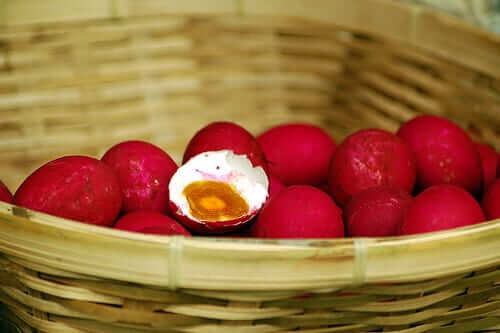
salted eggs

Ever wondered why “itlog na maalat” is salty? Hmmm…I’m wondering why some of the ladies started to smile. I’m not talking about the other “itlog na maalat”, please let me make this clear just to be sure that everyone is with me. What I’m talking about are the red salted duck eggs that we usually eat along with “Kamatis” (tomatoes) and are sometimes placed on top of Special Puto (rice cakes). I hope that we are all in the right track now.

Salted duck eggs are not only made and sold in the Philippines. In fact, the Chinese were the first ones to do the procedure. They make the duck eggs salty by soaking it in brine or placing each egg in damp salted charcoal. However, the ingenuity and creativeness of the Filipinos led them to create their own method of salting duck eggs. This method involves the use of clay or “putik” mixed with salt and water.

The duck eggs are soaked in the clay mixture then cured for quite some time. The curing process takes several days wherein the eggs are placed in trays and stocked in a temperature regulated room. This process actually lets the egg absorb the salinity from the clay mixture. Once the eggs absorb the right amount of salt needed, they are boiled and painted.

During this times, technology plays an important role in learning. Everyone can just sit in front of the computer and absorb information from the internet.

  • Previous
  • Page 1
  • Interim pages omitted …
  • Page 25
  • Page 26
  • Page 27

sidebar

Welcome!

As a huge fan of Filipino food, it is my goal to teach people how to cook it using the simplest way possible. Prepare your taste buds for an ultimate showdown of delectable Filipino dishes! Read more…

Facebook
Instagram
Pinterest
YouTube

Reader Favorites

Chicken Adobo Panlasang Pinoy

Filipino Chicken Adobo Recipe

Leche Flan Recipe

kare kare beef tripe

Kare-Kare Recipe (Beef Tripe)

Pork Sinigang

Sinigang

Receive new recipes by email!


Seasonal

Beef Morcon Recipe

Arroz Valenciana

lechon belly roll recipe

Lechon Belly Roll

Christmas Macaroni Salad

How to Make Macaroni Salad for the Holidays

As Seen In:

good housekeeping
parents
serious eats
livestrong
kitchn
sheknows
Facebook
Instagram
Pinterest
YouTube
About
Meet Vanjo
New? Start Here
Browse Recipes
Explore
Ingredient 101
Philippines
Cooking Schools
Privacy Policy
Disclaimers
Contact
© 2026 Panlasang Pinoy
Site Credits
Designed by Melissa Rose Design Developed by Once Coupled
Back to Top
Back to Top